
This recent Second Life scandal has some nonprofit board members concerned about the value for nonprofits using Second Life. Much like the Web, Second Life also has some seedy people out there. But as many nonprofits can attest, the ever-growing community of amazing avatars working for good far outweighs the few “bad apples” or rather “bad avatars.”
Here’s a list of 10 reasons why Second Life is worthwhile for your nonprofit:
1. Over 2 million people use Second Life. That’s a large community of people–and potential folks that your organization can reach.
2. Second Life offers new ways to collaborate and get work done. Through in-world meetings, people from disparate parts of the globe can chat (by text and voice), share documents and information, and work together on virtual projects.
3. It’s a carbon-friendly way to connect with people worldwide. Imagine the carbon (and cost savings) of participating in a global conference from the privacy of your own computer. OneClimate‘s OneWorld Island is offering just that with their Virtual Bali conference this fall, offering an alternative for people to participate virtually in the annual UN conference without the carbon cost of flying.
4. Low cost. The basic Second Life account is free, though there are additional costs for purchasing land. The Nonprofit Commons virtual space is donated land that allows nonprofits to set up virtual shop at no cost to the organization.
5. It gives your organization the opportunity to be thought leaders and innovators in your field of expertise. For example, Global Kids has run a series of virtual workshops on global issues and leadership to teens and are developing best practices for bringing this type of education into Second Life.
6. Second Life can provide a virtual sandbox for NPOs to experiment with different ways of building awareness and support for their cause. For Lower Eastside Girls Club of New York, developing a Second Life presence was a pilot project as a new program to contribute to their mission. Just as you have to try out a new fundraising or membership strategy, organizations can experiment with Second Life as another approach for meeting its goals.
7. Second Life awareness often translates into real-world donations. Consider the case of the Digital Campfires Foundation. Through connecting with others in Second Life, Digital Campfires received nearly a semi truck load of real-world donated monitors and computers.
8. Virtual worlds offer a level of interactivity that the Web can’t match. Take the Bay Area Video Coalition (BAVC) developed the Gone Gitmo project. This Second Life representation of Guantanamo Bay gives avatars a temporary simulated experience of what it’s like to be imprisoned in Guatanamo Bay and to teach about issues of habeas corpus.
9. Second Life fosters innovation and creativity. Nonprofits are continually coming up with new ways to gain awareness and touch people. Whether that’s through in-world concerts, virtual political debates or art exhibits, Second Life offers endless possibilities for creatively combining visual, text, and audio technologies.
10. Second Life is continually evolving and becoming increasingly sophisticated as technologies are developed. The possibilities for technical and social innovations in virtual worlds abound!
Written by: penguin kuhn
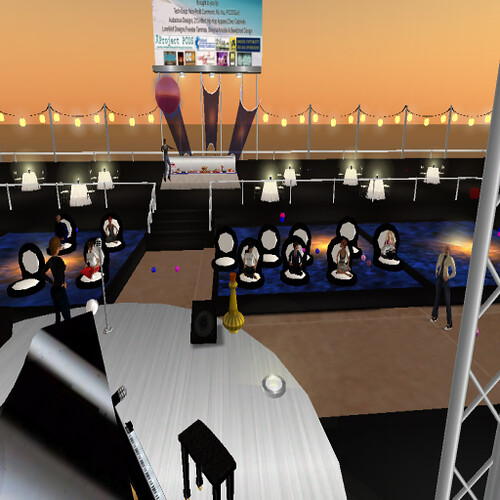
 Over 38.8 million people, in 110 countries participated in this years Stand Up and Speak Out event, a global initiative launched by the United Nations Millennium Campaign, to show support for the UN Millennium Development goals and against poverty. We joined them in their call by organising a Stand Up Against Poverty event in the virtual world Second Life. We had 70 visitors to our virtual Fight Hunger office at the Nonprofit Commons during the both events and it was really nice to meet so many interesting people and discuss ways to help end poverty and hunger. Our avatar Fight Hunchke had invaluable help of the avatar DrChaos Torok with organising the Stand Up event.
 During the Stand Up in Second Life, the visitors were given free Stand Up bracelets and T-shirts to show their support for the UN Millennium Development goals. Here you find a link to our
  The worldwide “Stand Up and Speak Out” event broke the Guinness World Record for the largest number of people to “Stand Up Against Poverty” in 24 hours. The record attempt took place over 16th and 17th October and was jointly organised by the United Nations Millennium Campaign and the Global Call to Action against Poverty with a wide range of other partners. The challenge saw millions of people physically and intentionally standing up against poverty, inequality and in support of the Millennium Development Goals. They spoke out to demand a more urgent political response to the growing crisis of global poverty.